Community
Types of Treatment
Depending on the cause of infertility, the following types of treatment may be recommended by your fertility specialist.
It is essential for you to consider the complexity, suitability, and the specific risk factors influenced by your health and causes of your infertility. You can also calculate your personalised chance of IVF success at: click here. The success rates of these treatment options are unique to everyone and depends on a variety of factors including cause of infertility.
We present these (very) brief summaries as a starting point for your own detailed research: a vital factor in your eventual success in achieving conception. Each technique has its own specific benefits and risks, all of which need to be taken into account with the assistance of your reproduction-focused healthcare providers. Speak with your Doctor to learn more about the best treatment approach for you.
Information
Types of Treatment
Ovulation Induction (OI)
OI uses hormone medication to stimulate follicle growth in people not ovulating regularly.
What are the benefits and risks of OI?
OI can be beneficial for people that have long, irregular, and infrequent menstrual cycles to help stimulate follicle growth and ovulation.
However, the fertility medications used in OI that help stimulate follicle growth can cause multiple follicles to start developing. This means more than one egg may be released when you ovulate which increases the risk of multiple pregnancies. Your specialist may monitor the follicles developing on your ovaries via ultrasounds to ensure only 1 or 2 follicles grow.
Another risk when using fertility medication is the risk of ovarian hyperstimulation (OHSS). OHSS can occur when your body is hyper-responsive to the medications given to stimulate follicular growth, which can lead to you becoming quite unwell. Symptoms include nausea, vomiting, diarrhea, shortness of breath, weight gain and dehydration. Although OHSS is less likely to occur during OI cycles and more during IVF cycles, where higher doses of medications are given, it’s important to be aware of the potential risk.
Artificial Insemination (AI) or Intrauterine Insemination (IUI)
In addition to being less invasive and stressful, IUI or AI can also prove more cost-effective. It involves inserting the sperm into the uterus around ovulation via a catheter. This can be done naturally or with hormone stimulation.
You should know that IUI does comes with risks such as multiple follicles, multiple pregnancies and potential OHSS (Ovarian Hyperstimulation Syndrome) — an exaggerated response to excess hormones. Careful monitoring is required to ensure properly controlled follicle growth.
IUI is often the choice for individuals with irregular cycles, minor sperm issues or relational infertility. Several rounds may be needed before considering other options such as IVF.
In-vitro fertilisation (IVF)
During your natural menstrual cycle, multiple follicles start growing. However, usually only 1 follicle is destined to ovulate and release an egg, as the rest go through cell death (atresia).
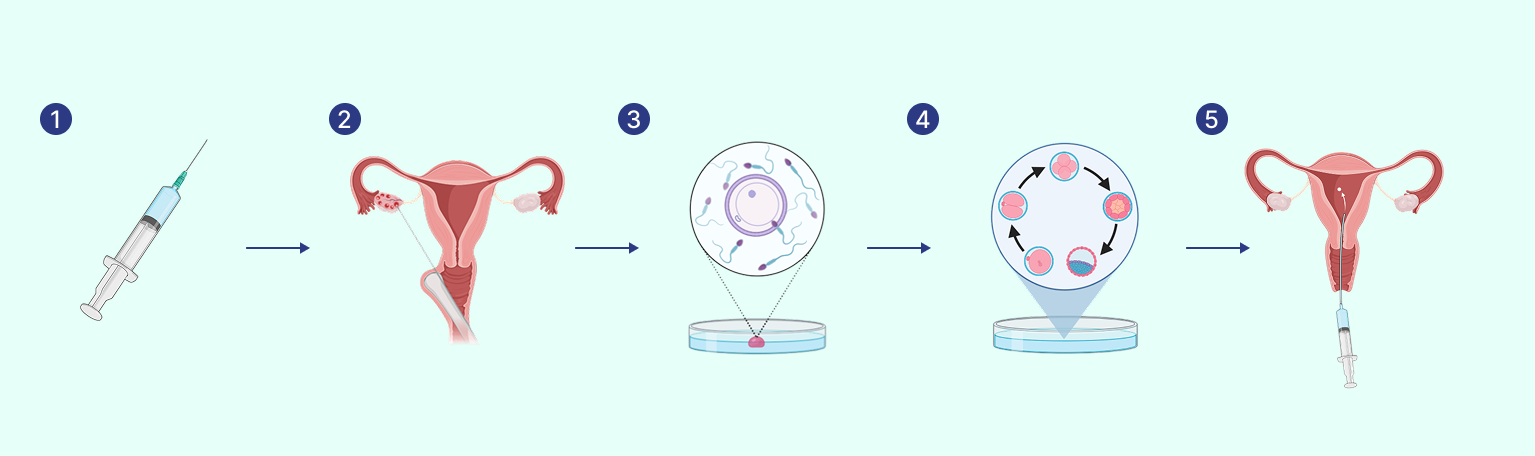
1. During IVF, hormone injections are used to stimulate the ovaries to help multiple follicles to develop and be monitored, often resulting in multiple eggs being collected.
2. When the developing follicles reach a certain size, indicating their potential to contain a mature egg (ready to be fertilised with sperm), they are retrieved in an ultrasound-guided procedure under light anaesthetic. Not every follicle contains an egg, however some will contain multiple eggs.
3. The eggs collected are placed with the sperm of your partner, or donor, in a culture dish in the laboratory to allow the eggs to hopefully fertilise, and embryos to develop.
4. The embryos are monitored, and development is assessed over a period of time.
5. Three to five days later, if suitable, one embryo is placed into the uterus of the woman or person undergoing treatment – this is an embryo transfer. If there is more than one embryo, the remaining embryo/s can be frozen and used in a future treatment known as a frozen embryo transfer (FET).
Intracytoplasmic Sperm Injection (ICSI)
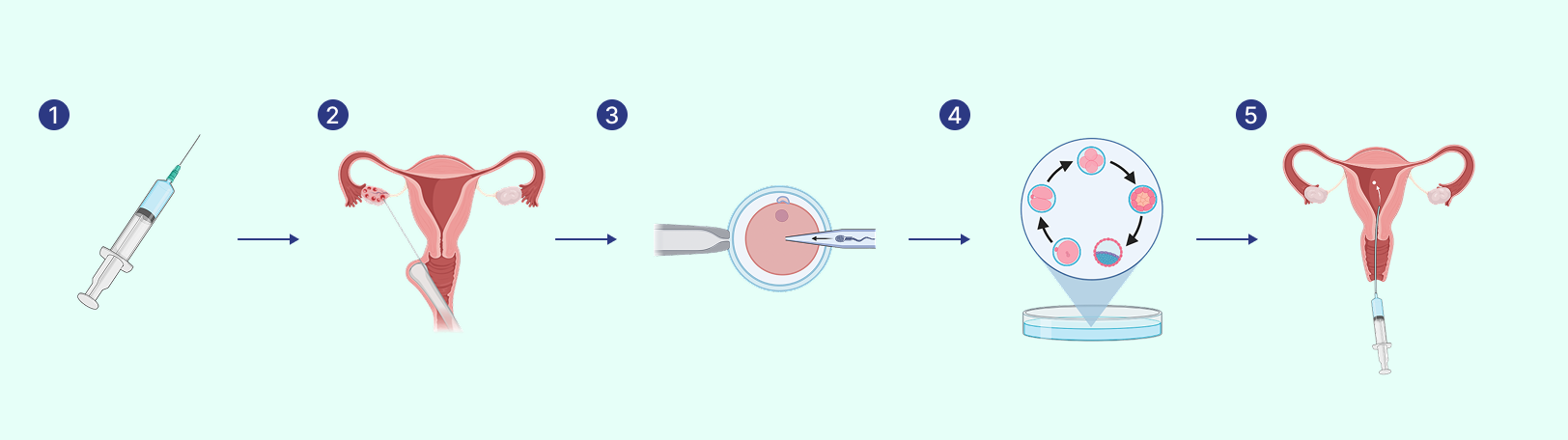
ICSI follows a very similar process to IVF, however, this time the embryologists identify and inject one sperm directly into the egg. It is used to increase the likelihood of fertilisation and live birth in cases of male infertility, and is sometimes used where IVF is unsuccessful.
While most pregnancies from ICSI proceed without complications, it carries a slightly higher risk of birth defects and a small chance of egg damage compared to unaided conception, with miscarriage rates similar to IVF.
The risk of miscarriage after ICSI is around 20% which is essentially the same as after IVF.
Frozen Embryo Transfer (FET)
How FET Works
A Frozen Embryo Transfer cycle occurs when a cryopreserved embryo created from a previous egg pick-up cycle is thawed and transferred into the uterus in the hope of achieving pregnancy.
Freezing embryos via vitrification gives patients some respite from repeated or back-to-back egg pick-ups. Not every patient will achieve frozen embryos in every egg pick-up cycle.
Preparation
FETs involve careful management of your treatment so that the stage of the embryo corresponds to the stage of the uterus at the time of transfer. For example, if your embryo is frozen on Day 5, it would then need to be transferred into the uterus 5 days after ovulation, or after 5 days of progesterone exposure, depending on your cycle type.
Depending on your specialist, your treatment may or may not involve medications such as progesterone. You may also like to discuss with your specialist the circumstances that would deem a FET more beneficial or more suitable for your treatment compared to a fresh embryo transfer, and vice versa, for your understanding.
Cost
Since a Frozen Embryo Transfer cycle requires the start of a new cycle, a new set of fees may apply. This will depend on your fertility clinic, so please talk to them to ensure clarity around this. They should give you a cost quote or a price guide. As a general rule, every time you report Day 1 of your cycle, there is likely a new set of costs.
Pre-implantation Genetic Testing (PGT)
What is Pre-Implantation Genetic Testing (PGT)?
PGT is a genetic testing method used to determine the suitability of an embryo for transfer to a woman’s uterus in the hope of achieving pregnancy.
The process occurs after IVF treatment is used to create embryos. Then, at around day 5, a few cells are carefully removed for biopsy. This biopsy assesses the cells for the correct number of chromosomes (genetic material), structural rearrangement of chromosomes, and/or a specific gene or genes, depending on the type of PGT in your treatment plan. A report is then sent to your specialist or clinic advising the results of each embryo that were biopsied for testing.
Want to understand the different PGT types? Learn more below.
Donor Conception
Donor conception is the process of having a baby using donated sperm, eggs or embryos through self-insemination or fertility treatment such as IVF. Sometimes it involves surrogacy, too. Donor conception involves a donor (the person donating sperm, eggs or an embryo) and recipient parent(s) who receive the donation. A child born as a result of the donation is known as a donor-conceived person.
For more information about Donor Conception, please click the button below.
DISCLAIMER: We are a fully volunteer-run organisation. If you find any information on this website you believe is incorrect or needs updating, please let us know at hello@artfam.com.au.
Acknowledgement of Country
ARTFam & ASMBC acknowledge the Traditional Custodians of the land on which we live, work, and build our families. We pay our respects to the Elders past and present, and we honour the strength, knowledge, and enduring connection that Aboriginal and Torres Strait Islander peoples have to family, community, culture and Country.
Sign up for newsletters